

HOSPITAL NAME Hospital Center
DOCTOR Dr. Laurentiu Popescu
THE CATARACT
DEFINITION
Cataracts represent clouding of the lens, a lens in the eye that is behind the iris.
It remains a very common pathology, more than 450,000 eyes are operated on in France annually.
CAUSES OF CATARACT
There are several factors for the appearance of cataracts, but the main factor is aging. Thus, from the age of 60, a large number of patients present a more or less annoying onset of cataract depending on the type of lens opacification.
Cataracts can also appear in younger people and in this case it is often bilateral and symmetrical.
Other situations can remain at the origin of cataracts:
nutritional factors (tobacco, alcohol, certain nutritional deficits)
environmental factors (mostly unprotected UV exposure)
eye pathologies (diabetes, glaucoma, myopia, uveitis, retinal surgery)
traumatic cataracts
congenital cataracts
THE EVOLUTION OF THE CATARACT
The evolution of cataracts can take place over several years. The main symptoms are reduced visual acuity, difficulty in driving at night, discomfort in the light accompanied by glare and halos (photophobia).
In the absence of surgical treatment, vision can deteriorate sharply and complications can occur:
acute glaucoma
uveitis
a dislocation of the lens
complete loss of vision
PRE-OPERATIVE OPHTHALMOLOGICAL CONSULTATION (FULL ASSESSMENT)
visual acuity assessment
fundus of the eye
biometrics
eye pressure assessment
explanation of surgery
other exams may be performed to look for other abnormalities (B ultrasound, corneal topography, specular microscopy)
This assessment is generally carried out at the medical center, but sometimes requires additional examinations on a specialized technical platform (polyclinic of Cesson-Sévigné).
The secretariat schedules the surgery with the patient. Pre- and post-operative instructions, written information about the operation and practical information (place, date, appointment, telephone numbers) are issued and the patient's consent is obtained on the day of the operation. The obligatory prior anesthesia consultation appointment and postoperative appointments are also set.
CATARACT SURGERY
The surgeon performs the operation in outpatient surgery (entry in the morning, discharge the same day) in the operating room of CH Simone Veil in Vitré. The operation is generally performed under topical anesthesia (anesthetic eye drops) + intravenous sedation by a dedicated team of anesthetists.
Very exceptionally, it can be performed under general anesthesia.
The intervention consists of two stages and takes place in 10 to 15 minutes on average:
THE EXTRACTION OF THE CRYSTALLINE
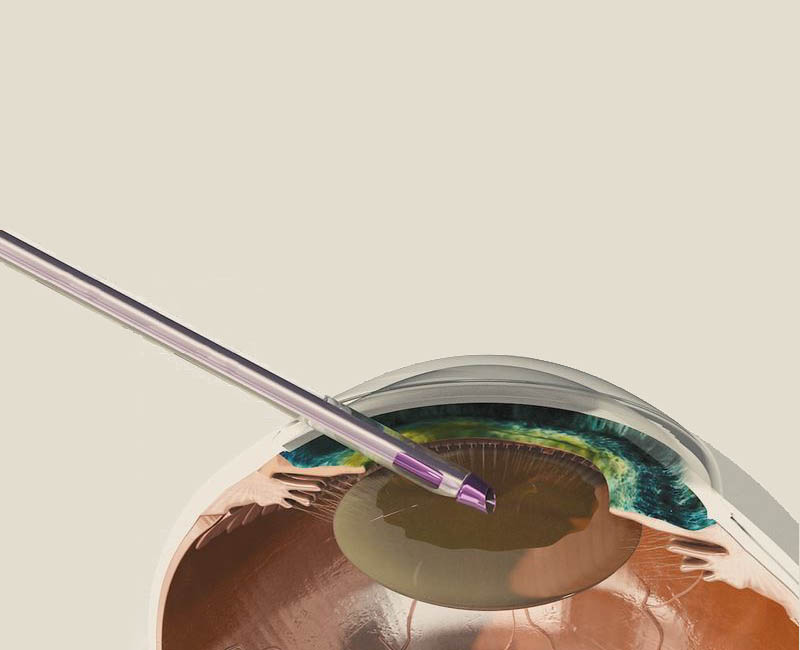
1. Extraction of the lens - is carried out under an operating microscope; after instillation of Betadine on the eye, a 2.2mm incision is made in a clear cornea and the anterior chamber is filled with a viscoelastic product so that the cornea is protected during the operation.
The anterior capsule is opened by forceps (capsulorhexis), the cataract is broken and aspirated by a device (phakoemulsification = ultrasound).
PLACING THE IMPLANT:
2. Placement of the implant - the implant is introduced into the eye after being bent; it unfolds into the lens sac left in place. At the end of the operation, a protective dressing is placed over the eye to prevent eye trauma.
POSTOPERATIVE SUITES
Leaving the CH in Vitré is a few hours after the operation.
The dressing is removed the day after the operation by the surgeon during the D + 1 visit. A follow-up consultation is scheduled 1 month after the operation which ends the treatment and allows the adaptation of the correction by glasses if necessary.
The post-operative instructions are recalled and the post-operative care prescription is issued. These are eye washes and eye drops prescribed for 1 month. This care is usually carried out by the patient or his family and does not necessarily require nursing care.
Eye irritation is usual for the first 24 hours.
Visual recovery is fairly rapid (between 1 and 5 days depending on the case). However, pain or significant loss of visual acuity requires prompt contact with the surgeon.
Secondary cataract
Sometimes after the cataract surgery you can have a clouding of the posterior capsule - a secondary cataract.
In this case, a YAG laser capsulotomy should be planned (cutting of the posterior capsule with the laser which lasts a few moments, remains painless and takes place in the office).
If you want you can schedule an appointment
OR Call us on 09 86 34 99 22
Outside of practice opening hours and in case of emergency, please contact 15 or contact the CHU Pontchaillou in Rennes or the CH in Laval.

Doctor Laurentiu Popescu, ophthalmologist, consults at 6 Boulevard de Chateaubriant in Vitré in Ille-et-Vilaine.
Useful Links
National Council of the Order of Physicians French Society of Ophthalmology Ordinal compliance charter applicable to physician websites Legal Notice CNOM e-HealthAccess Map
OPHTALMO VITRE 36 Boulevard de Châteaubriant, 35500 Vitré, France
- Parking Gare de Vitré EFFIA nearby; Champ de Foire car park nearby - Bus nearby: Line 3 stop 70ème RI, Chateaubriant or Tremoille; line 7 Chateaubriant or Trémoille stop - Access to the SNCF train station on foot 400mContact
(+33) 09 86 34 99 22
https://www.ophtalmo-vitre.fr
LJ 9: 00-13: 00 and 14: 00-18: 00
V 9: 00-13: 00 and 14: 00-17: 00